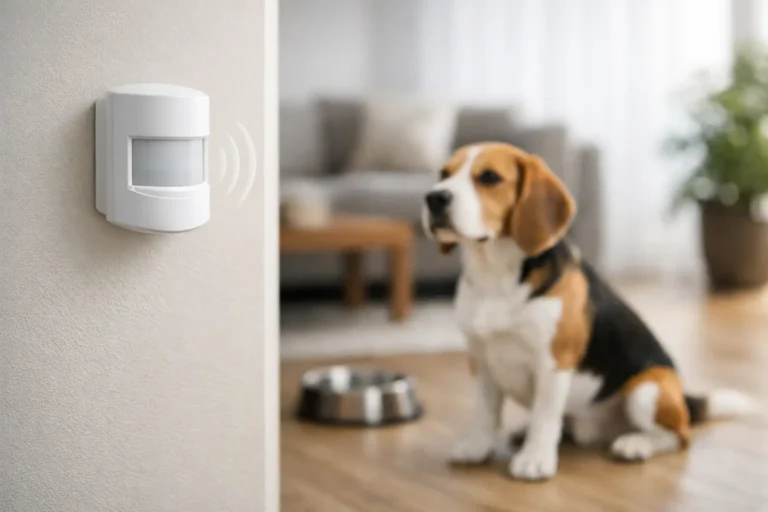

A dog racing through the living room should not trigger the same response as an intruder crossing it at 2 a.m. That is the goal of a pet friendly motion sensor setup: dependable detection that protects your home while allowing your pets to live normally. Getting there takes more than choosing a sensor labeled “pet immune.” The sensor type, mounting height, room layout, pet behavior, and system programming all affect whether your alarm responds appropriately.
For Louisiana homeowners, placement also matters because sunlight, warm rooms, ceiling fans, open floor plans, and doors that lead to active outdoor areas can all influence motion detection. A professionally designed system accounts for the everyday movement in your home before an alarm ever goes live.
Why Pet-Friendly Motion Detection Needs Planning
Most indoor motion detectors use passive infrared technology, often called PIR. Rather than simply watching for movement, a PIR sensor looks for changes in infrared energy, which is associated with body heat. When a person moves across its detection zones, the sensor recognizes a meaningful change and can trigger an alarm.
Pet-immune sensors are designed to disregard smaller heat signatures near the floor, usually up to a stated pet weight or combined weight. That feature is useful, but it is not a guarantee that every pet will be ignored in every room. A 20-pound cat that jumps onto a bookshelf can enter the sensor’s main field of view. Two dogs that play together may create a larger heat signature than either pet alone. A large dog standing on its hind legs can also look very different to a sensor than the same dog walking across the floor.
The practical question is not simply, “How much does my pet weigh?” It is, “Where does my pet go when the system is armed?” A good design begins with that answer.
Plan Your Pet Friendly Motion Sensor Setup Room by Room
Before selecting sensor locations, take a normal walk through your home from your pet’s perspective. Notice where your dog sleeps, where your cat climbs, which doors your pet watches, and whether your pet has access to furniture near likely sensor locations. The goal is to protect key paths an intruder would use while avoiding rooms where pet movement is constant.
Many homes do not need a motion detector in every room. Door and window contacts protect opening points, while motion detectors provide interior backup coverage. This approach can let you arm perimeter protection at night while everyone, including pets, moves freely inside. During an away mode, properly located interior motion sensors add another layer of detection.
Start by identifying the most valuable interior areas: a central hallway, a living area with multiple entry paths, or a room that connects the garage to the rest of the house. Then decide whether your pet can safely be kept out of that area while the system is armed. If the answer is yes, a standard motion sensor may be an option. If not, a pet-immune model and careful placement are necessary.
For homes with cats, look up as well as down. Cats often turn an otherwise suitable room into a difficult motion-detection environment because they use sofas, counters, stairs, shelves, and window ledges. In some cases, it is better to rely on door and window protection in a cat’s favorite room rather than force a motion sensor into a space with many climbing routes.
Place Sensors Where Pets Are Least Likely to Enter Their View
Motion sensors are commonly installed in corners, aimed across the expected path of an intruder. Cross-room movement is generally easier for a sensor to detect than movement directly toward it. That placement can also help a technician shape coverage around a room’s natural traffic patterns.
Avoid aiming a sensor at places where pets regularly jump or perch. A detector pointed toward the top of a staircase, the back of a couch, a cat tree, or a tall piece of furniture may see a pet at the same height where it expects to see a person. Furniture placement can change over time, so keep this in mind before moving a bookcase or adding a tall kennel near a detector.
Keep detectors away from direct sunlight and significant heat changes when possible. Sunlight moving across a floor, a fireplace, a supply vent, or a space heater can create conditions that make accurate detection more difficult. In Louisiana, doors opening to a hot garage or patio can also bring sudden temperature changes into an entry area. The solution is not always to avoid the room entirely, but it does mean the sensor should be positioned thoughtfully.
Do not install a motion detector where it looks through glass toward outdoor activity. Moving people, vehicles, animals, and changing sunlight outside can create unnecessary complications. Similarly, take note of ceiling fans, hanging decorations, and curtains near air vents. These are not always a problem, but they should be evaluated during installation rather than discovered after a false alarm.
Match Sensor Settings to Your Pets and Your Routine
Pet immunity has limits set by the equipment and the installation. A sensor may be rated for pets up to a certain weight, but that rating assumes the pet stays near the floor and moves through the area as expected. If you have multiple pets, use their combined activity as the standard. A pair of medium-size dogs wrestling in front of a detector is a different situation than one dog walking through the room.
Some sensors offer sensitivity adjustments. Lowering sensitivity may reduce false alarms, but it can also reduce detection performance if it is not done carefully. This is one reason settings should not be treated as a trial-and-error project. Security equipment is meant to detect a real threat reliably, not merely stay quiet.
Your arming routine matters just as much. If your pets are crated, confined to a bedroom, or kept in a pet-safe section of the home while you are away, tell your security provider. That information can change which rooms receive motion coverage and which are best protected with contacts or glass-break detection instead. A customized design is usually more dependable than trying to make one sensor solve every security need.
It is also wise to test your routine after installation. Arm the system as you normally would, leave the home, and confirm that pets can move in their designated areas without causing alarms. If your pet’s habits change, such as a new puppy gaining access to furniture or an older dog being moved to a different room, revisit the plan.
When Professional Installation Makes the Difference
A motion sensor may look simple on the wall, but its effectiveness depends on details that are easy to miss. The correct mounting height, angle, field of view, sensor model, and relationship to doors, windows, and heat sources all matter. A professional installer can evaluate the home as a complete security system rather than placing devices one at a time.
That approach is especially helpful in homes with open living spaces, high ceilings, multiple pets, indoor pet gates, or frequent visitors. It is also valuable when homeowners want smart security controls that show system activity and make it easier to arm or disarm the home from a phone. The technology should fit your routine, not add another chore to it.
Alarm Center Security has helped Louisiana families protect their homes since 1985, with professionally installed systems designed around the way each household actually lives. A local security team can recommend the right mix of sensors, contacts, cameras, and monitoring services while providing support when your needs change.
Common Questions About Pets and Motion Sensors
Can I use motion sensors if I have a large dog?
Yes, but the best solution depends on where the dog stays and how it behaves. A large dog may exceed the stated pet-immunity limit of many sensors, especially if it jumps on furniture or moves through a central room. You may need to keep that room off limits while armed or rely more heavily on perimeter protection.
Will a pet-immune sensor ignore my cat?
Not always. Cats are often more challenging than dogs because they climb. A cat moving across the floor may be ignored, while the same cat on a counter, shelf, or couch back may enter the sensor’s primary detection area. Room selection and sensor aim are critical.
Should I turn off motion sensors to avoid false alarms?
Turning off interior motion detection can reduce protection when you are away. A better option is to adjust the system design so pets can occupy safe areas while key interior paths remain covered. Professional monitoring adds another measure of response if an alarm is triggered.
A security system should give your family confidence without asking you to choose between protection and the pets that make your house feel like home. The right system should notice an intruder, not every trip to the water bowl.