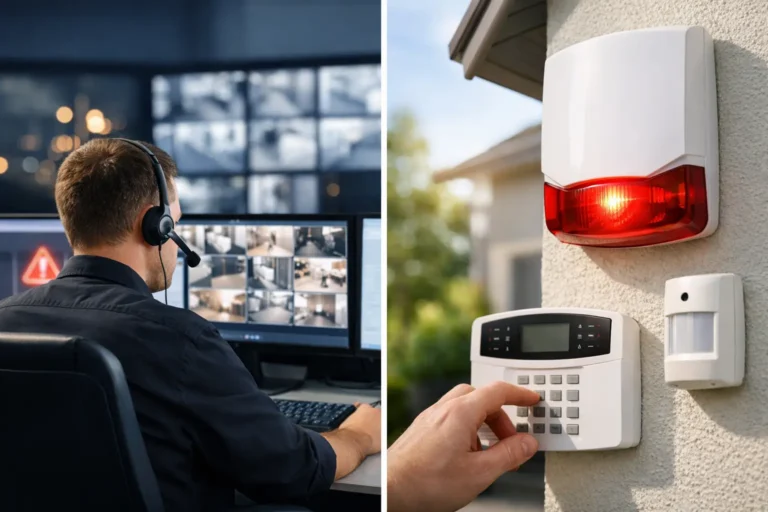
A loud siren can get your attention fast. The real question is what happens next. When people compare monitored vs unmonitored alarms, they are usually trying to answer one practical concern – who responds if something goes wrong when you cannot?
That answer matters for homeowners leaving for work, families traveling out of town, and business owners locking up after hours. The right choice depends on your property, your routine, your budget, and how much support you want when an alarm event happens.
Monitored vs Unmonitored Alarms: The Core Difference
The simplest difference is this: a monitored alarm system is connected to a professional monitoring center, while an unmonitored alarm system relies on the siren, local alerts, and your own response.
With monitored service, an alarm signal is sent out when the system detects a break-in, fire event, panic signal, or another programmed condition. Trained operators then follow an established response process, which may include calling you, checking the situation, and contacting emergency responders when needed.
With an unmonitored system, the equipment still detects activity and can still make noise, send app notifications, or trigger lights and cameras. But there is no professional monitoring team stepping in behind the scenes. If you miss the alert, are in a meeting, are asleep, or are out of cell range, the system cannot escalate the event on its own.
That is why this decision is less about gadgets and more about responsibility. A monitored system shares that responsibility with a professional team. An unmonitored system keeps it mostly in your hands.
How Monitored Alarm Systems Work
A monitored system typically includes door and window sensors, motion detection, control panels, and often smoke detection, carbon monoxide detection, cameras, and smart home controls. Once armed, the system watches for activity based on how it is programmed.
If something triggers the system, the signal is transmitted to a monitoring center. Depending on the setup, that can happen through cellular communication, internet connection, or backup paths designed to improve reliability. The monitoring center receives the signal and follows the response instructions tied to the account.
For many property owners, this is where the value becomes clear. If a burglary alarm goes off at 2 a.m., a professional team is already responding while you are waking up and trying to understand what happened. If a business alarm trips during a holiday weekend, there is still a process in place even if no one is on site.
Professional monitoring can also be useful for signals that are easy to miss but serious in consequence, such as fire, low temperature conditions, or a panic alert. In those moments, speed and consistency matter.
How Unmonitored Alarm Systems Work
An unmonitored system still performs a useful security function. It can detect unauthorized entry, sound an alarm, activate cameras, and send notifications to your phone. In some cases, that is enough to scare off an intruder or help you quickly check live video.
This approach appeals to people who want to avoid monthly monitoring fees or who prefer to manage everything themselves. For a small property with a simple routine, that may feel like a reasonable trade-off.
But unmonitored systems create gaps. A siren may be ignored by neighbors. A phone alert may arrive while you are driving, flying, sleeping, or in an area with poor service. You may see the alert and still not know whether it is a false alarm, a delivery issue, a family member entering late, or a real emergency.
That uncertainty is where many people start reconsidering the cost savings.
Which Option Responds Faster?
In real-world use, monitored systems usually provide a more dependable response path. That does not always mean police or fire services arrive instantly, because local dispatch procedures vary. It does mean there is a dedicated team receiving the signal and acting on it.
With an unmonitored alarm, the response time depends on you noticing the event, interpreting it correctly, deciding what to do, and then making the necessary calls. That can be perfectly manageable during the day when your phone is in hand. It is less dependable when life gets busy.
For businesses, response consistency is often a deciding factor. Owners and managers cannot monitor every alert around the clock, especially across evenings, weekends, employee turnover, and multiple entry points.
Cost Differences and What You Are Really Paying For
Unmonitored alarms usually cost less month to month because there is no professional monitoring service attached. You may still pay for equipment, installation, app access, cloud video storage, or maintenance, but recurring costs are often lower.
Monitored alarms add a monthly fee, and that naturally gets attention. The better question is what that fee replaces. In many cases, it replaces the burden of being the only person responsible for every signal, every alert review, and every after-hours event.
It also supports the infrastructure behind the service – trained operators, communication systems, account management, emergency procedures, and ongoing support. For many families and business operators, that is not an extra. It is the part that makes the system dependable when it matters most.
The least expensive option is not always the lowest-risk option.
Monitored vs Unmonitored Alarms for Homes
For homeowners, the choice often comes down to lifestyle. If you work away from home, travel regularly, have children, care for an older family member, or simply want backup when you are asleep, monitored service often makes more sense.
It also pairs well with broader home protection. Many professionally installed systems can connect intrusion detection with smoke alarms, smart locks, video doorbells, garage access, lighting controls, and mobile management tools. That gives you both convenience and a stronger response plan.
An unmonitored system may be enough for someone in a small residence who is home often, watches alerts closely, and mainly wants deterrence. But even then, there is a difference between hearing a siren and knowing someone is actively helping manage the situation.
Monitored vs Unmonitored Alarms for Businesses
For commercial properties, monitored systems are often the stronger fit because the risk picture is broader. A business may need intrusion protection, after-hours monitoring, opening and closing accountability, employee access awareness, and support during times when no manager is present.
If an unmonitored system sends an alert at midnight, someone still has to see it and decide how to respond. If that person is unavailable, asleep, or assumes it is a false alarm, valuable time can be lost.
Professional monitoring helps create a more structured response. That matters for retail stores, offices, warehouses, churches, medical offices, and other properties where a delayed reaction can lead to theft, damage, interrupted operations, or safety issues.
The Role of Professional Installation
The monitored versus unmonitored decision is only part of the equation. System design matters too. Poor sensor placement, weak communication paths, confusing controls, or one-size-fits-all equipment can limit performance no matter which option you choose.
That is why professional installation matters. A properly designed system takes your layout, habits, entry points, and risks into account. It also gives you someone to call when you need service, upgrades, or training.
For Louisiana property owners, working with a local company can make that support feel more practical and personal. Alarm Center Security has served local homes and businesses since 1985, and that kind of experience shows up in system planning as much as in monitoring.
So Which One Is Better?
If your top priority is the lowest monthly cost and you are comfortable handling every alert yourself, an unmonitored system may meet your needs.
If your top priority is dependable response, added peace of mind, and real support when something happens, monitored service is usually the better choice.
For most families and most businesses, security works best when it does more than make noise. It should notify the right people, support quick action, and give you confidence that you are not handling an emergency alone.
A good alarm system should fit the way you live and work, not force you to fill in the gaps yourself. The best choice is the one that still protects your property when your phone is off, your schedule is full, and your attention is somewhere else.