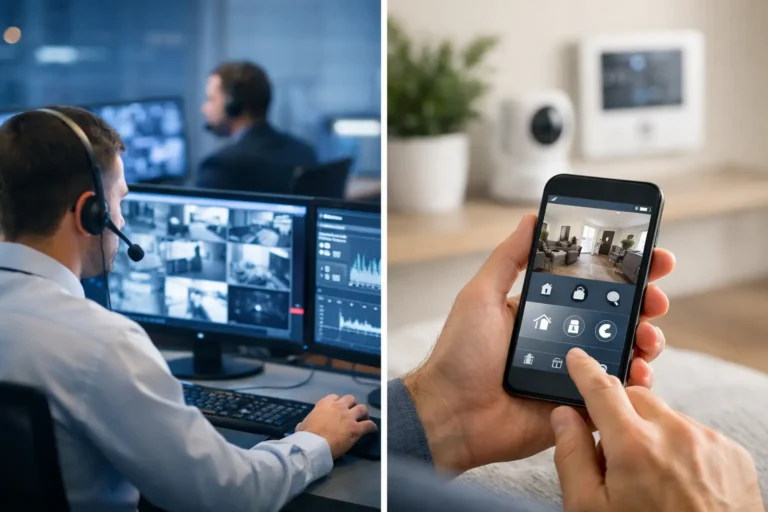
A security alert at 2:17 a.m. creates one immediate question: who is responsible for acting on it? With alarm monitoring vs self monitoring, the equipment may look similar – sensors, cameras, a smart app, and a control panel – but the response plan is very different. The right choice depends on how quickly someone can respond, how much responsibility they want to carry, and what is at stake if an alarm is missed.
For Louisiana homeowners, a monitored system can mean help is already being contacted while the family focuses on getting to safety. For a business owner, it can mean an after-hours alarm is addressed even when the owner is traveling, asleep, or unable to check a phone. Understanding the difference before choosing a system helps protect more than property. It protects time, routines, and peace of mind.
What professional alarm monitoring does
Professional monitoring connects a security system to a staffed monitoring center. When an intrusion, fire, panic, or other supported alarm signal is received, trained operators follow an agreed-upon response plan. Depending on the event and the system setup, that may include calling the property, contacting designated keyholders, and dispatching emergency responders.
The most meaningful benefit is coverage when the customer cannot respond. Phones get silenced during meetings. Batteries die. Families travel. Business owners may be several hours away when a rear door opens after closing time. A professional monitoring center is built to receive and act on alarm signals around the clock, rather than relying on one person seeing a notification at the right moment.
Monitoring does not eliminate every decision. Customers still choose who should be called, update their contact list, and decide which events should trigger alerts. But it puts a trained team behind the system when an emergency requires immediate attention.
Response is the central difference
An alarm is only as useful as the response it prompts. With professional monitoring, the alarm signal is not sitting in an app waiting for someone to notice it. It enters a response process designed for urgent events.
That matters especially for smoke, carbon monoxide, medical, and panic alarms, where seconds can feel very long. It also matters during a break-in, when confronting an intruder or returning to a potentially unsafe property is never a good plan. The goal is to give first responders the information they need while keeping people out of harm’s way.
Professional monitoring also helps when a business has multiple opening managers or a homeowner has adult children, caregivers, or neighbors listed as contacts. A clear call list and response instructions reduce confusion when an alarm occurs.
What self monitoring asks of you
Self monitoring uses app notifications, text alerts, emails, and camera clips to notify the system owner directly. The owner reviews the alert and decides what to do next: check live video, call a neighbor, contact the police, or dismiss the notification as a false alarm.
For some properties, this is a reasonable approach. A person who is almost always available, has a low-risk second property, or mainly wants awareness from cameras may prefer to manage alerts independently. Self monitoring can also appear less expensive each month because there is no professional response service attached.
The trade-off is simple but significant: the owner becomes the monitoring center. That means staying reachable, recognizing which alerts are urgent, and making the right call under pressure. If a phone is out of service, notifications are overlooked, or an alert arrives during a flight, the system may record an event without anyone taking action.
Self monitoring also requires a realistic look at notification fatigue. A camera that sends frequent motion alerts may be useful at first, but many people eventually silence alerts or stop checking every one. A professionally designed system can help reduce unnecessary signals through appropriate device placement and settings, but no alert strategy works if it is routinely ignored.
Alarm monitoring vs self monitoring for homes
A home is rarely empty on a predictable schedule. Children come home from school, pets move through rooms, family members leave for work at different times, and vacations create long stretches without anyone nearby. Professional monitoring is often the stronger fit for families who want protection that continues whether they are awake, at work, or out of town.
It is particularly valuable for households with older adults, young children, or anyone who may need help during a medical or fire emergency. A monitored alarm can support a broader safety plan that includes intrusion detection, life-safety devices, smart locks, video verification tools, and remote control through a compatible smart security app.
Self monitoring may fit a homeowner who wants camera awareness at a vacation property or prefers to receive alerts before deciding whether to involve anyone else. Still, it is worth asking a practical question: if an alert arrives while you are driving, in a crowded event, or asleep, who is backing you up?
What businesses should consider
For a business, missed alarms can affect inventory, employee safety, operations, and insurance requirements. Retail stores, offices, warehouses, and service companies often need more than a camera notification after hours. They need a defined response when a door is forced, a motion detector activates, or a fire alarm signal occurs.
Professional monitoring supports business owners who cannot personally answer every event. It can work alongside access control, surveillance cameras, opening and closing reports, and customized user codes to provide better visibility into daily operations. If an employee forgets to arm the system, arrives outside normal hours, or triggers an alarm, the owner has a clearer path to follow.
Self monitoring can be useful as an added layer for managers who want real-time camera alerts and remote system control. It is less dependable as the only plan for a property that holds valuable equipment, sensitive information, cash, or inventory. A business should not depend on one manager’s personal phone as its sole after-hours security response.
Compare the real costs, not just the monthly bill
The lower monthly cost of self monitoring is appealing, but it is not the only cost to evaluate. Consider the time spent reviewing alerts, the stress of deciding whether an event is real, and the risk of delayed action. For many households and businesses, the value of professional monitoring is not that alarms happen often. It is that a plan is in place when one does.
Professional monitoring has an ongoing service cost because trained operators, communications infrastructure, account management, and response procedures are involved. The exact price depends on the system, the types of devices connected, and the services selected. A reliable provider should explain those costs clearly and help design a plan around the property rather than pushing a one-size-fits-all package.
Installation quality deserves equal attention. Poorly placed devices, weak communications, or a system that is difficult to use can create false alarms and frustration regardless of the monitoring choice. Professional installation helps ensure equipment is selected and positioned for the building, the people using it, and the risks that matter most.
Questions that lead to the right choice
Before deciding, think through real-life scenarios rather than ideal ones. Who will receive an alert at night? Who can respond when the property is empty? What happens during a storm, a family trip, or a day when every manager is in the field? Is there a life-safety concern that deserves an immediate professional response?
Also consider the people who will use the system every day. A security plan should be easy enough for family members and employees to follow confidently. Clear user codes, dependable mobile control, training, and local support make a meaningful difference over the life of the system.
Alarm Center Security has helped Louisiana customers build protection plans around those practical questions since 1985. With more than 10,000 installed systems, the team understands that the best system is not simply the one with the most devices. It is the one that fits the property, the people inside it, and the response needed when something goes wrong.
A good security decision should leave you with a clear answer to the middle-of-the-night question: if an alarm sounds, help does not depend on whether you happen to see your phone.